Friday, September 24, 2010
Fanfiction Follies

Wednesday, September 22, 2010
Mizushō Fanfic
Monday, September 6, 2010
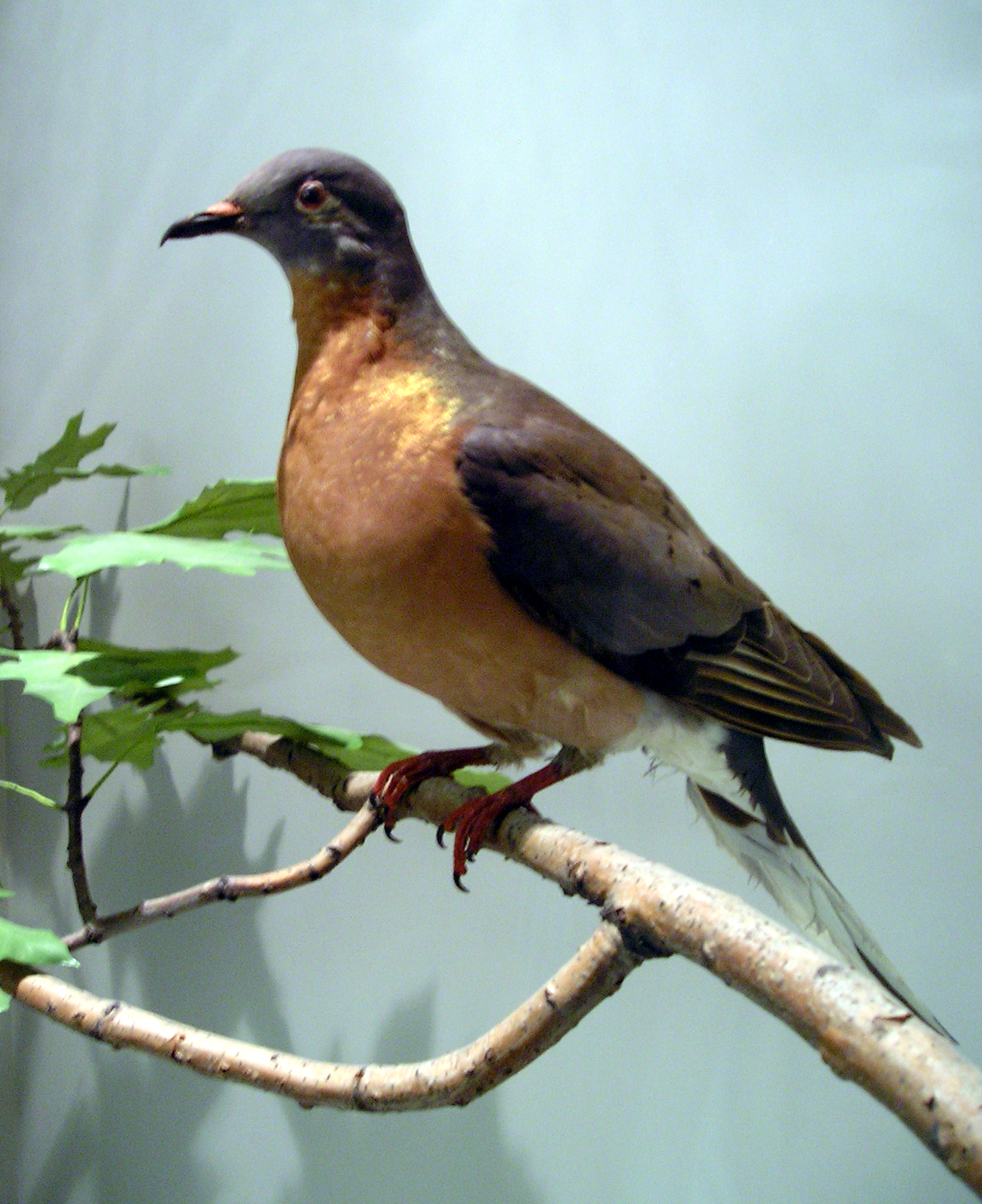
The Passenger Pigeon (Ectopistes migratorius)
This may have been the most numerous species of bird that ever lived on Earth. It was larger than the rock dove, a once-rare species that has established itself in cities around the world, what almost any North American thinks of when hearing the word “pigeon.” Ectopistes migrated from place to place in enormous flocks, nesting and feeding in the deciduous forests—the forests that weren't made up of pine trees. At least a quarter of North America was covered with deciduous forests when the first European settlers arrived. It may not have flown quite as well as the smaller pigeons that are often raced by hobbyists, but it could fly over any tree. Despite that, it nested on the ground. This doesn't sound like the best strategy for making sure enough of your eggs become descendents instead of breakfast, but it worked for a long time.
In 1878, one hunter in Michigan shipped about three million dead Passenger Pigeons to eastern markets. In 1890, no hunters shipped any Passenger Pigeons from Michigan because there weren't any left.
Pigs also played a part in the decline of the market for Passenger Pigeons. Continuing the practice from prehistoric times, immigrant farmers from Europe turned loose hogs in woods to forage. The hogs actually came back from the woods because hogs are smart enough to be trained like dogs to return to the sound of a horn, or a whistle, or a Slim Whitman CD if you feed them to that sound when they are piglets. It is not known who first discovered this, but it's pretty certain his or her name wasn't Pavlov or Slim Whitman.
It isn't known exactly why all the Passenger Pigeons are gone now. We're pretty sure that white people had something to do with it, and pigs which nearly all got eaten by white people because white people have more money to buy pork products, and because pigs haven't gotten smart quite smart enough yet to figure out that the man or the woman feeding them now is planning on eating them later, or selling them to someone else to eat to get enough money for the next Slim Whitman CD. But white people, with or without their pigs, have put some serious hurt on other species and so far most of them are still around, even if they're harder to find now. Quite some time before the last of the Passenger Pigeons were gone from the wild, professional Passenger Pigeon hunters either found new work or starved to death because getting money for not working wasn't invented until the 1920s in the United Kingdom, where there were never were any Passenger Pigeons (and it was way to far to swim there) and wasn't imported to North America until the discovery in 1932 that people with no money living in their cars ("Hoover Chariots") or in clusters of cardboard boxes ("Hoovervilles") or in vacuum cleaners ("Hoovers"), or even sleeping on the ground under discarded newspapers ("Hoover blankets") could vote for someone who wasn't Herbert Hoover ("Hoover"). The professional hunters did not finish off the Passenger Pigeons because the average expenditure to stay breathing long enough to find a Passenger Pigeon plus ammunition to kill it was less than you could get for the Passenger Pigeon, and the hunter couldn't even break even if he (or she) ate the damned thing. White people who could afford something else don't seem to have eaten Passenger Pigeons, even if they ate pigs that ate Passenger Pigeons, Passenger Pigeon eggs, Passenger Pigeon poop, or even Passenger Pigeon hunters. There's more than one reason you shouldn't sleep with a pig.
The last Passenger Pigeon died in 1914, in the Cincinnati Zoo. Her name was Martha. What's left of her is on display at the U.S. Museum of Natural history.
While a nearly complete specimen of this species is preserved and is on public display at the National Museum of the United States Air Force in Dayton, Ohio, its ecology is largely a matter of conjecture. It was a migratory predator, probably too large to hunt other flyers, although it was capable of bursts of speed up to Mach 3.08. Its feeding grounds were extremely restricted, no more than a few committee rooms in the District of Columbia. It's nesting grounds, however, were much more extensive, including Moscow, Beijing, Pyongyang, Havana, and possibly Hanoi. No observations of the North American Valkyrie laying its eggs have been confirmed, but the prevailing theory is that it laid one to four parachute-retarded thermonuclear eggs of 1 to 30 Megatons at the end of its high-speed dash and then abandoned them, completing its life-cycle. Since it surfed on its own shock wave, focused downward by its downfolded wingtips, whomsoever was under its final flight path would have been pretty sure that the Wrath of God or something close to it was overhead.
Thursday, July 8, 2010

Thursday, June 3, 2010
Lesson 37
If you don't know already, Mizusho got kicked off of Mangafox along with a lot of other "mature" series. I'm looking for other homes.
Wednesday, May 12, 2010
My g/f got me a DVD of Avatar, so I finally got to see it. Even without 3D, it's a good movie, though after reading the original script I think it would been a better movie if there was a little more backstory.
The latest IMDB review complains that it's a ripoff of Star Wars, which it is not. If anything, it's “inspired” by a Harry Harrison novel from the 1960's, Deathworld. That novel featured human colonists fighting the ecology of a planet that was all linked together in an empathic gestalt, so that the harder they fought, the meaner and tougher the hostile critters got. Admittedly the colonists weren't servants of a greedy megacorporation; they were simply annoyed at the small hazards of country life when they first landed, such as bug bites and plants with thorns. They got mad...and the ecology responded to their anger, starting the cycle. I'll bet James Cameron has read that novel.
Another possible source of inspiration is Alan Dean Foster's Midworld, which features human colonists who've gone “native” and fight to defend their home tree.
James Cameron is probably going to do at least one sequel, but first will come (I really hope this time) Battle Angel.
Monday, May 3, 2010
I've read two outstanding books over the last week: Tokyo Vice by Jake Adelstein and Last Train From Hiroshima by Charles Pellegrino. The first is relevant to the Mizushō background because it has a lot of stuff about the water trade and Yakuza involvement in it. There's even a chapter called “Welcome to Kabukichō.” The second book is a tougher read, though it is beautifully written. Last Train has been optioned by James Cameron, so we might see a spectacularly gruesome recreation of the Hiroshima and Nagasaki bombings.

_at_the_rollout_061122-F-1234P-015.jpg)
_061122-F-1234P-019.jpg)